maanantai 10. elokuuta 2015

Branding yourself / Mira Koivumäki-Lindholm


Branding yourself
Branding yourself is important at nowadays job market. More and more companies are seeking for good employers via LinkedIn. 
It seems to me that branding yourself is important. 
Is it necessary? Not yet, at least in Finland, I think. You can still find a job just using job application and your CV.
I found this interesting article (very American, to me honest) which tells you how to create a powerful personal brand. I comment my opinions based on this article.

Sell Yourself: 14 Steps to Creating a Powerful Personal Brand

http://www.salary.com/sell-yourself-14-steps-to-creating-a-powerful-personal-brand/
“One of the best ways to articulate your skills, experience, knowledge, and overall worth in today's competitive job market is to create a personal brand that helps you stand out in the crowd. This article explores 14 steps to creating a successful personal brand.”
How to do it?
Step 1: Determine your unique value proposition
“Spend some time thinking about what makes you different than your peers -- your strengths, your passions, and your goals. If you left your job today, what would your company and colleagues miss? Know who you are, as well as who you are not.”
=>
I think this is very good advice. In any job interview you need to tell your weaknesses but most important your strengths! This isn't easy – especially for Finns, so it's good to analyze what kind of person I am and also what kind of employer I am. 
When I started my study leave I had worked at the same company for 8 years and it was very hard to say was I important to my company or not. But it was very encouraging to see that they really missed me when I was gone. 
I tried to make notes for my duties and ways to handle my job, but still when others needed to take care of my tasks it wasn't so easy for them.
I think everybody should take study leaves or other breaks from work time to time – it is very instructive.
Step 2: Find out how others see you
"Ask trusted colleagues, co-workers, and friends for four or five adjectives they would use to describe you. What are you good at? What are your strengths? In which areas do they view you as "irreplaceable?"
=>
I tried this advice and got these opinions:
- Mira is a faithful and reliable employee.  
- Mira concentrates and devotes on assigned tasks carefully.  
- Mira does her job smoothly and quickly.  
- As a colleague Mira is a cheerful, fun and social.”
How encouraging! :)
Of course by 8 years experience you'll find easier ways to do your job, you know your tasks but especially: you know EVERYBODY – your colleagues, subcontractors, clients and so on – and that makes everything so much easier. You don't have to start from the scratch.
Step 3: Identify your goals
“Where would you like to be in six months? One year? Five years? Ten years? Defining your goals is necessary to crafting a message that helps you reach them.”
=>
This advice I find also very good. I have heard that when you dream of something you also take steps to get what you dream of, and finally you can see yourself living in your dream, your dreams have gone true.
If you set goals that are specific and if you set the target that is realistic – you will get it.
Aphorism says:
“By choosing our path, we choose our destination.”
Step 4: Identify your target audience
“Just like Starbucks knows that their target audience is coffee drinkers, you need to define to whom you want to send your message. This will not only help you hone your message, it will help you deliver it to the right places.”
=>
Well, yeah – true. For example if I wanna start a blog I need to start by thinking who would read it.
Step 5: Reorganize your priorities
“You're probably used to putting yourself behind your company, co-workers, and clients. You still want to be loyal to these groups, but be loyal to yourself, first.”
=>
This is so true! I have always been too humble. 
I don't want to bring myself up – sometimes it's good but sometimes you just need to take the credit of your good job. How could your superior find you irreplaceable if you don't let your strengths to see?
Step 6: Pay attention to the details
“Everything you do ultimately contributes to your personal brand. Once your brand has been defined, make sure that the little things -- the way you dress, your body language, how you behave with co-workers, the emails you write -- are consistent with your brand message.”
=>
Once again, of course true - for example - if you are at job interview.
At daily job I don't know how much time do you have to control everything? A little bit unrealistic? 
Step 7: Update your resume
“Go through your resume to determine it gels with your brand. Ensure that your resume accurately defines who you are, and is in line with both your short-term and long-term goals.”
=>

True. It is important (for example) that your LinkedIn profile is updated. It gives a poor impression of you, if your data is very outdated.

Step 8: Become a social networker
“Set up accounts at social networking sites such as Facebook and Twitter. Ask those in your target audience to subscribe to your pages, and update on a daily basis. Make sure your updates are germane to your branding message.”
=>
Hmmm... a little American way...
Yes, it's important to be active at social media and via Twitter, Facebook and LinkedIn you can find interesting job opportunities, but to “ask my target audience to subscribe my pages”, I think this is little too much.
Step 9: Build your own website
"Your website should highlight your professional accomplishments, your skills and knowledge, what you stand for, and your overall value. Make it primarily about you, not your company or clients."
=>
If I am a politician or wannabe-politician, then OK, but if I'm just one Mira from Turku – I don't think so. :)
Step 10: Blog
“Platforms like WordPress and Joomla make it easier than ever to promote yourself to your target audience. Commit to posting a couple of times a week on topics that your audience will find interesting and educational, but that also highlight your unique skills and experience.”
=>
True – you can write a blog of your interests, your hobbies, your studies – and that's what we practice now!
Step 11: Get published
“Write a book, contribute to industry publications, or simply update the content on your own website. Being published is an ideal way to promote yourself as an expert in your field.”
=>
Good advice – but a little overwhelming for me..
Step 12: Go offline
“Be sure to promote your brand in person, too. Join and participate in industry groups, give talks at conferences, or offer to spearhead a large project that highlights your unique talents.”
=>

When you have reached a high enough position, you usually get to give speeches at conferences – but at my position, this is not an issue yet.

In any case, live performance is what matters most.
You can tell everybody how important person you are on-line, but face to face encounters are most valuable.

Step 13: Tend to your marketing network
“Be sure to keep co-workers, colleagues, clients, and friends updated about what you are doing. Word of mouth is a powerful marketing tool, and what the people in your network say about you will ultimately have an effect on your brand.”
=>

On LinkedIn's Skills & Endorsements is based on the idea what people in your network say about you. You should keep LinkedIn up to date!

Step 14: Review your brand (and how you portray it) frequently

“Are you portraying your brand in a way that's concise and easily understood? Is your brand message consistent among all platforms? A regular review will ensure your message remains clear.”
=>

A good summary! Clear, simple message is important at all communication.
It is worth to re-write your CV time to time.

keskiviikko 5. elokuuta 2015

Company at Facebook and City of Turku at Facebook / Mira Koivumäki-Lindholm


What to remember when company / organization is using Facebook?

CONTENT
I thing the most important thing is creating valuable content. To do so you need to know your audience and it's needs.
Here is a quote from learning materials:

“Take the time to think about why you and your brand want to engage Facebook and what you hope to achieve from doing so. But don’t stop there. Think about your audience, specifically the segment of your audience on Facebook.”

It's good to remember that the fastest growing segment of users is women 55 to 65 years old! So perhaps I have to ask of myself is the Facebook right media for my company?
 
How to write interestingly? Few good tips:

  • Make it fun: text needs to fit the unofficial model of a Facebook post.
  • Have a call to action: make it clear what action you want users to take.
  • Focus on engagement: give exclusive offers for being your friend.
  • Content should also be regularly updated! At learning material there was request to post every day. That is not necessarily my opinion, I think few times a week is better.
  • Don't oversell or undersell: one of the five posts should be a sales message and four posts will be other helpful or fun content.

Couple of other useful reminders:

PAGE OPTIMIZATION

You should learn to use search engines effectively.

Leaning material:
“To make sure you are getting and keeping fans requires applying some basic search engine optimization skills and including keywords in your content, for both Facebook and overall organic searches, so your page can be found through the site and on the Internet.“
 
PROMOTING OR ADVERTISING
Promoting or advertising at Facebook can be made several ways, example:
  • by using paid advertising,
  • organic promotion or
  • incentive offers.
VIDEOS

Many Facebook users like watching videos!
Learning material:
“Articles that announced they contained a video were shared more than those that didn’t.”


CITY OF TURKU AT FACEBOOK


Official news

I like City of Turku's present in Facebook. They inform official news at Facebook such as this example where Tallink ordered new passenger car ferry from Meyer Turku.


Events

City of Turku promotes events regularly, like these resent events: moonlight swimming, Regatta and Jazz event and H2Ö festival. They also use videos to promote events even better!


Competitions


They organize different competitions at Facebook. 
Here is example of two of those.

Turku Society selects every year Turku Flikka and Poika, one girls and one boy - whose task is to represent the young people of his hometown in events arranged by City of Turku, the local business community as well as various associations.


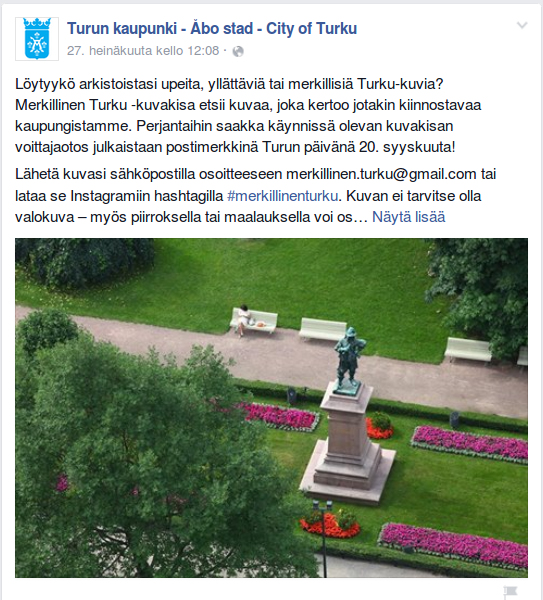
“Strange Turku”competition is looking image 
that tells something interesting of Turku.


Fast and active on responding
 

City of Turku Communication is very active to follow the conversation at web and also gives quickly answers to citizens. 


Other Facebook pages and groups


City of Turku has also some other Facebook sites like Turku region official tourism site Visit Turku.

Kulttuuria Turusssa is City of Turku's best cultural events guide as well as the benefits and deals.

Here is listed all the groups City of Turku has at Facebook and also other social media channels: http://www.turku.fi/some

Social media gone wrong


Last two assignments
Ella Härkönen

This assignment was definitely my favorite one! Leeeeet's go!

These days when social media is on everyone's hands (figuratively and literally) posting something one must be sure that they really want it on air. It is almost too easy to take screen shots of something and then share it onward.

I work with customers and YES, it gets annoying sometimes. I get called with names if I do not grant all of customers wishes, people threat to get me fired etc. Luckily there are way way way more nice, amazing customers than these negative ones, but still one bad customer can really ruin your day.

So when customers give you feedback online, the company must always keep its cool. Like Michaela posted with the water-case an angry answer can really ruin the company's reputation. And no, deleting the original post does not help!

Me, myself experienced something similar.


Anyway, I had a little beef with Sonera since they refused to fix my phone even though it was their responsibility. Eventually they held my phone for "further inspections" until the warranty of the phone was over and then they called me and informed that it is not their case anymore since the warranty time is passed now. Obviously I was FURIOUS since they had my phone for months and decided not to do anything until after the warranty-time!

I posted on my Facebook wall what happened. I got lots of likes and comments and then someone suggested me to post this on Sonera's wall. I did it and got an answer saying that "No, not our fault". After that my post got thousands of likes and hundreds of angry people commented on how rude they were and how dare they. A day after my Facebook-post they posted that "we are willing to give you a new phone!".

They did wrong in the first place,  but their biggest mistake was to simply write "no, not our fault". After people saw that they were so angry (me included!) so they totally should have repaid the phone in  the first place. Oh, by the way, the new phone they send me broke down after one month of using it -Sonera still said that not their responsibility so I changed the company to DNA.


This another case makes me crack.

Saying "be careful what you wish for, because you just might get it" holds true here! I bet that NYPD thinks twice before posting photos like this again!


Social media in ten years

Something being this big as it is makes me wonder how much bigger can it get! An easy presumption is that schools will stop having traditional mechanisms of teaching and more and more of ebooks and e-exams are being used- in elementary level as well.
In working life traditional meetings can be history soon too. Holograms and skype-method meetings can be the new way of doing things.


Now I feel really the urge of going outside! The sun is shining and I am ready to leave all of the social media back home and go enjoying the beautiful summer day. This is my last post- please leave comments and have an amazing rest of the summer!

Case Study: Join the movement

CASE STUDY ASSIGNMENT 
ELLA HÄRKÖNEN


As for my case study, I chose the company I work for and to which I am doing my thesis: Stadium. Stadium is a Swedish sportswear/equipment company that has stores in Sweden, Finland, Denmark and Germany.

For this assignment I interviewed the person in charge of  Stadium Finland's social media, Ms. Erander. I chose to leave out her first name here, since this is a public arena where I post this assignment.

Stadium has outsourced their social media marketing, meaning that an outside company is designing and posting Facebook and Instagram advertisements. Every country has their own Facebook pages and the posts come in the country's own language. Erander is in big role in Finnish Facebook posts:"My job is to translate from Swedish/English to Finnish whatever the company is sending us, but in all honesty, I have to modify them a lot to look "Finnish"." People can also post their feedback on the Facebook page.

However,  Stadium's Instagram profile is the same one in all of the countries. The language of the profile is English so that everyone can understand the posts. There are motivation quotes, photos of new collections, images of celebrities wearing Stadium's clothes and competitions. The objectives of both Instagram and Facebook is to motivate people to healthier life style (their motto is Join the Movement and mission to Activate the World) and the spread awareness of the brand. "These days there is no choice of NOT being all over the social media- it is a must. Using Facebook and Twitter is a cost-consciousness and fast way of showing people who we are. We want to inspire people and build our brand in an efficient way" Erander states.


Stadium also has an Instagram account for the Staff in each country. Stadium Staff Finland- account is meant for all of the employees in Finnish stores. "With the Staff-account we want to build team spirit among the employees. It is fun to follow what your co-workers at the other side of Finland are doing and get motivated by that!" Erander also noted that even though anyone of the staff can pretty much post anything to the account, it is important to control it. "There has not been any problems with the account, but it is still important to keep an eye on  that account as well."

Another channel inside of the company is the Intranet, where news inside of the company is posted. It is an efficient way to let the staff know what is happening. Once a week comes a bigger "weekly letter" where sales of the previous week are went through and more info is also shared.

Stadium has not given any specific code of conduct to the staff regarding their usage of social media. However, Stadium trusts the staff that they do not do anything to harm the company's image.

Once a month Stadium receives an evaluation of marketing campaigns -also in social media. "Once a month is good, but it could be more frequent as well. It is a place to improve for us! Things are changing so rapidly these days"

All in all, Erander and me both agreed that the social media usage in Stadium is looking really good. Obviously there are always places of improvement, but so far everything looks like it should.


tiistai 4. elokuuta 2015

Doing business in Wikipedia / Mira Koivumäki-Lindholm


Doing business in Wikipedia / Mira Koivumäki-Lindholm

Teacher's example: http://fi.wikipedia.org/wiki/Gefilus

Article about Lactobacillus rhamnosus GG has a clear marketing purpose!
First the article brings you scientific text about Lactobacillus rhamnosus bacteria - how healthy it is.
Then there is strong reminder how you should have at least one glass of milk or goblet of yogurt a day which contains this bacteria. 
By the way Valio has pre-thought-out right amount for you!
 
Here is a quote from scripture:

“Lactobacillus GG:n määrä vaihtelee eri tuotteissa, mutta yksi päiväannos tiettyä elintarviketta (esim. lasillinen maitoa, mehua tai piimää, tai pikarillinen jogurttia) sisältää aina terveysvaikutusten kannalta riittävän määrän bakteeria. Lactobacillus rhamnosus GG -maitohappobakteeria lisätään muun muassa maitoihin, juustoihin ja mehuihin (esimerkiksi suomalaisiin Valio Gefilus -tuotteisiin)."

Here you'll find just the right Premier Gefilus products! :)

Article continues:

“LGG on Valion rekisteröity tavaramerkki --- Tuotevalikoima on vuosien myötä laajentunut ja siihen kuuluu jogurtteja, piimää, maitoa, tehojuomia, mehuja, mehukeittoja ja juustoa. Lapsille suunnatut Valio Kidius Gefilus -tuotteet sisältävät myös LGG-bakteeria."

Finally, numerous studies of Lactobacillus rhamnosus GG and how, for example, Lactobacillus rhamnosus GG containing milk in a Helsinki daycare centers reduced caries - compared to regular milk.
Although studies must be true, the powerful connection to Valio products clearly looks like marketing.


I saw interesting article, which talks about ethical wiki.
http://ethicalwiki.com/resources/Ethical_Wikipedia_Marketing_and_Public_Relations.pdf

There is something to learn about..
Page 8:
 
"What is neutral?

This is a tricky subject, since even veteran Wikipedians often have disagreements about what is neutral for a specific article or topic.

A neutral Wikipedia article not only carries a neutral tone but is representative of the available
literature on the subject. Some “neutral” Wikipedia articles may have a negative meaning and others positive, depending on the available citations. This is important to keep in mind for marketers that may be tempted to author a History section that omits major controversies or a Reception section that only summarizes positive product reviews. It may be considered dubious to “hide” information or contribute in an obviously one - sided way.

This puts marketers in an uncomfortable position, because inevitably some sources about the company
will include points of view the organization doesn’t agree with and information that does not serve its
best interest. That’s the conflict of interest aspect. You’re expected to include this information fairly the same way a crowd sourced participant would.

If that doesn’t make you or other stakeholders uncomfortable if there is no tension involved – you may be doing something wrong.

One key to success is for the organization to have an advocate for ethics involved in the process; someone who will persuade stakeholders, push for honesty and advocate for a fair contribution. The organization will be faced with the temptation to stretch things, omit information, cherry-pick what sources they use and other slanting and someone needs to help the organization resist temptation.

Fight for your organization’s longterm integrity as an honest contributor that Wikipedians can trust. It will serve you in the long run."

Page 10: 

"Things to avoid

  • Avoid promotional sections like Awards, Philanthropy, Recognition or Corporate Social Responsibility.
  • Avoid creating separate articles on the company and its products if they can be consolidated.
  • Avoid creating an excessively detailed article in general.
  • Avoid bullets in most cases, especially if they are long lists of individual products, partners, locations or executives.
  • Avoid articles that are focused on products or executives rather than the organization’s heritage.
  • Avoid using citations that merely repeat what the company told them, such as rewritten press releases.
  • Avoid using too many primary sources, such as the company website.
  • Avoid using an overly official tone or writing style, both in the article’s content and in discussions with editors."

Successful blogger / Mira Koivumäki-Lindholm


SUCCESSFUL BLOGGER

Successful Finnish blogger: Huono äiti (Sari Helin)
http://www.huonoaiti.fi/huono-aiti/
Huono äiti (Poor Mother) is a character whose life is such as human life really is. Huono äiti is living a life that is not perfect. Huono äiti herself is reporter Sari Helin.
Huono äiti's stories deal with life. Femininity, virility, couple relationships – or life without relationship, children, food, cars, houses, life in constant chaos - and everything in between.
The blog 's popularity is based on the fact that this is an ordinary people and ordinary life. Mother can also be very tired and powerless. There isn't always success, life is sometimes challenging, sometimes very difficult, but still worth of living. Finns are melancholic, so this kind of negativity suits for us.
Calling herself a poor mother Sari doesn't rise above her readers - she gets readers to her side.
Writers at the blog are Sari and all the blog followers, who have just now something to say. Huono äiti has risen to the blog community. Huono äiti is Finland's most popular family blog!
Huono äiti Facebook-group and blog was born in the United States, where Sari lived for a long time. She explains that before she was doing different marketing and communication works and she wrote columns in various magazines. She has written also three books. But because of living in US it wasn't so easy to find a job, so she started to write a blog and started her own Facebook group.
Huono äiti is a registered trademark. It is now more than just a blog, there is for example on-line shop where you can find mugs and other goods with Huono äiti brand.
Sari Helin has also Huono äiti TV program where you find interviews with the same themes as written in the blog. This is why Huono äiti is also a good business!


I also found some examples of world known and famous successful bloggers.
Successful female bloggers:
http://www.successfulblogging.com/start-a-blog/
There is still one thing to be popular with blogging then earn real money.
Here is a list of the best earning bloggers around the world: http://www.therichest.com/rich-list/world/worlds-10-top-earning-bloggers/?view=all

Good and bad example of company blog / wiki - Mira Koivumäki-Lindholm


GOOD AND BAD EXAMPLE OF COMPANY BLOG / WIKI
A good example of company blog is OP-Pohjola Group's Taloudessa.fi-blog.
http://taloudessa.fi/
Taloudessa.fi won the best Finnish company blog 2014 competition.
Blog content is interesting, the look is attractive, the structure is
meaningful and debate is active.
 
Blog's theme “Kukkarossa” is approaching consumers' everyday life as concretely as possible. At
“Yrittäjältä” section entrepreneurs tell about their everyday lives. 
The latest addition is customer service blog. And that is about the situations and questions
that customer service has occurred.

Many
writers work at the OP 's communication but there also other
specialists. At the “Yrittäjältä” blog writers are
entrepreneurs from many different environments and different
companies.
The company has arranged for writers coaching- and training sessions. As a result authors are enthusiastic and well motivated. This has reflected interesting topics and points of view. I think the authors write understandably, close to everyday life.
OP's experts have gained the blog useful for customer service. They get valuable feedback and they can improve their services based on customers opinions.

The blog has succeeded to deal with a broad macro economy and on the other hand the consumer's point of view.

Then bad example.
I was very difficult to find a bad example. When I searched examples I came across opinions and conclusion like: “corporate blogs are the least trusted information source of all”. Some experts gave an advise: “If you're a company thinking of starting a blog "about your company and its products", you probably shouldn't bother.”
Pretty negative thinking!
We all know that there are some corporate blogs that you trust more than others. To claim that corporate blogs are the least trustworthy information source on the planet seems untrue. Whether corporate blogs are trustworthy, it depends on many things, for example, it depends on the style of blogging, the content that's published, the way the blog is promoted, and so on.
If the company or the brand itself is off-putting or unreliable, why relying on blog? In addition, if the blog is a transparent product marketing , then it at least does not make things any easier...
Still it was hard to find bad examples – people talk about things that make a blog a poor, but no one dares to point the finger at bad example. As I read - all in the name of honesty - blogs so marginally, it is difficult to tell you the bad example.
Anyway, I went through the 100 largest Finnish company list 
(https://fi.wikipedia.org/wiki/Luettelo_suomalaisista_yrityksist%C3%A4_liikevaihdon_mukaan)
... and wanted to see how they are telling about themselves at Wikipedia. 
I found out that most of the writings were quite constructive - observations came mainly from the spelling or the fact that the writings didn't tell directly the sources.
Still these are big, well known companies, why not upgrade the Wikipedia page a little?
Example:

I also checked my employer Wikipedia pages (https://fi.wikipedia.org/wiki/Sitra_%28rahasto%29) and noticed that even if the content was effective, however, some of the facts were out of date.
Who would remember to keep this particular source of information up to date ?!